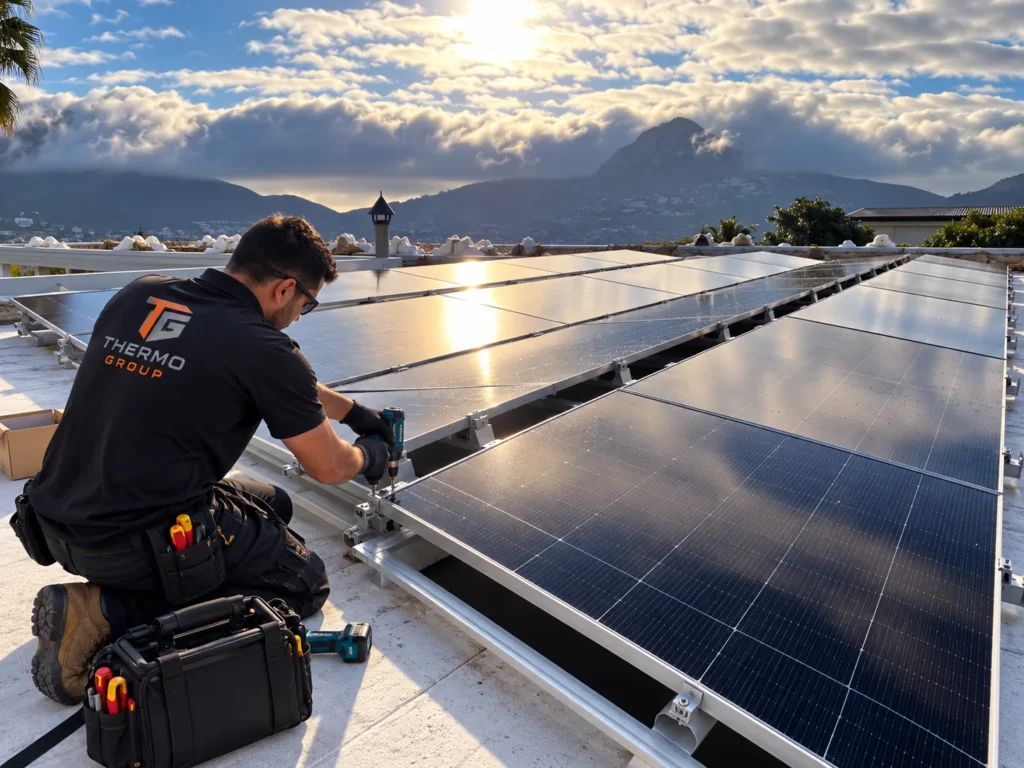
Thermo Group solar installation with dramatic mountain views in Hout Bay

Affordable Solar Installations Hout Bay

Thermo Group — Solar Experts You Can Trust

Affordable solar installations for homes and businesses in Hout Bay — quality workmanship, transparent pricing, no premium mark-up.

At Thermo Group, we install solar PV, battery and hybrid systems throughout Hout Bay — a valley ringed by mountains on three sides, with a microclimate and harbour salt air that reach further inland than most homeowners expect. We design every Hout Bay system around those conditions from the first site visit, not as an afterthought.

Credentials & trustECA member (Electrical Contractors' Association of South Africa)SAPVIA member (South African Photovoltaic Industry Association)Holds PV GreenCardRated 4.9 on GoogleFree quotes, no call-out fee

Thinking about solar in Cape Town?

Free solar quotes, no obligation. Installation and City registration handled for you.

Call 021 203 5337 Call 082 302 0683 Get a Free Quote

Free solar quote · no obligation

Tell us about your home in 5 quick steps

No prices on screen and no pushy sales. We call you back the same day, do a free site assessment, then send an accurate written quote.

Step 1 of 5

Where is the property?

Type of property

Prefer to talk? Call 021 203 5337 or WhatsApp 082 302 0683

Our experienced team handles the complete solar installation process in Hout Bay — from surveying the property’s actual sun hours and shading, through design, installation, testing, compliance and registration.

Whether you’re looking for a solar PV system, battery backup, hybrid inverter or a complete energy solution, we design around your property’s electricity usage, roof and the valley’s own weather. We carry out both residential and commercial solar installations, and our technicians are experienced in installing and maintaining these systems for the long term.

Two Sunsynk hybrid inverters with Hubble batteries and protection boards in Cape Town

Complete Solar Solutions

Our solar services include:

  • ☀️ Solar panel installations
  • 🔋 Battery storage systems
  • ⚡ Hybrid and backup inverter systems
  • 🏠 Residential solar installations
  • 🏢 Commercial solar installations
  • 🔧 Solar system upgrades and expansions
  • 📋 Electrical compliance and certification
  • 🏙️ SSEG applications and registration
  • 📝 Solar system registration with the City of Cape Town
  • 🔍 Solar system inspections and fault finding
  • 🛠️ Ongoing solar maintenance and servicing

What We Design Around In Hout Bay

☀

Mountain Shading & System Sizing

Chapman’s Peak, Karbonkelberg and the Table Mountain National Park ridge cut direct sun earlier or later depending on which side of the valley a property sits. We map actual sun hours on site before sizing a system, not off a generic Cape Town estimate.

✈

Harbour Salt Air & Hardware Choice

A working fishing harbour means salt-laden air reaches further into the valley than most homeowners expect. We specify marine-grade brackets, connectors and earthing hardware at installation, so corrosion isn’t something a new system develops in its first year.

💧

Valley Moisture & Roof Sealing

Hout Bay traps more mist and moisture than the open suburbs just over the mountain. Getting roof penetrations, flashing and cable routing right at installation matters more here than in a drier suburb.

Why A Hout Bay Solar Installation Isn’t A Generic Cape Town Job

Hout Bay sits in a valley ringed by mountains on three sides — Chapman’s Peak, Karbonkelberg and the back of Table Mountain National Park — with a working fishing harbour at its centre. That geography makes its own weather: more mist, more moisture, and shading patterns that change from one street to the next. We don’t quote a Hout Bay installation off a standard sun-hours table. Our site visit maps where the sun actually falls on your specific roof through the day, at different times of year, before we recommend a system size.

Thermo Group installing a solar system on a rooftop in Hout Bay

Getting System Size Right In A Valley That Shades Itself

Depending on which side of the valley a property sits, Karbonkelberg or the Table Mountain National Park ridge can cut direct sun earlier in the afternoon than an open suburb would get. Undersize a system without accounting for that and you end up with a homeowner disappointed by their own production numbers a year in. We size every Hout Bay installation around the property’s real sun hours, not a generic estimate for the Cape Peninsula.

Built For Harbour Salt Air From Day One

Hout Bay is built around one of the busiest fishing harbours on the Western Cape coast, and the salt air that comes with a working harbour reaches further inland than most homeowners expect — we see the same corrosion patterns here that we see in beachfront suburbs, even on homes with a mountain view rather than a sea view. Every Hout Bay installation gets marine-grade brackets, connectors and earthing hardware from the outset, so it’s not something that has to be corrected in year two.
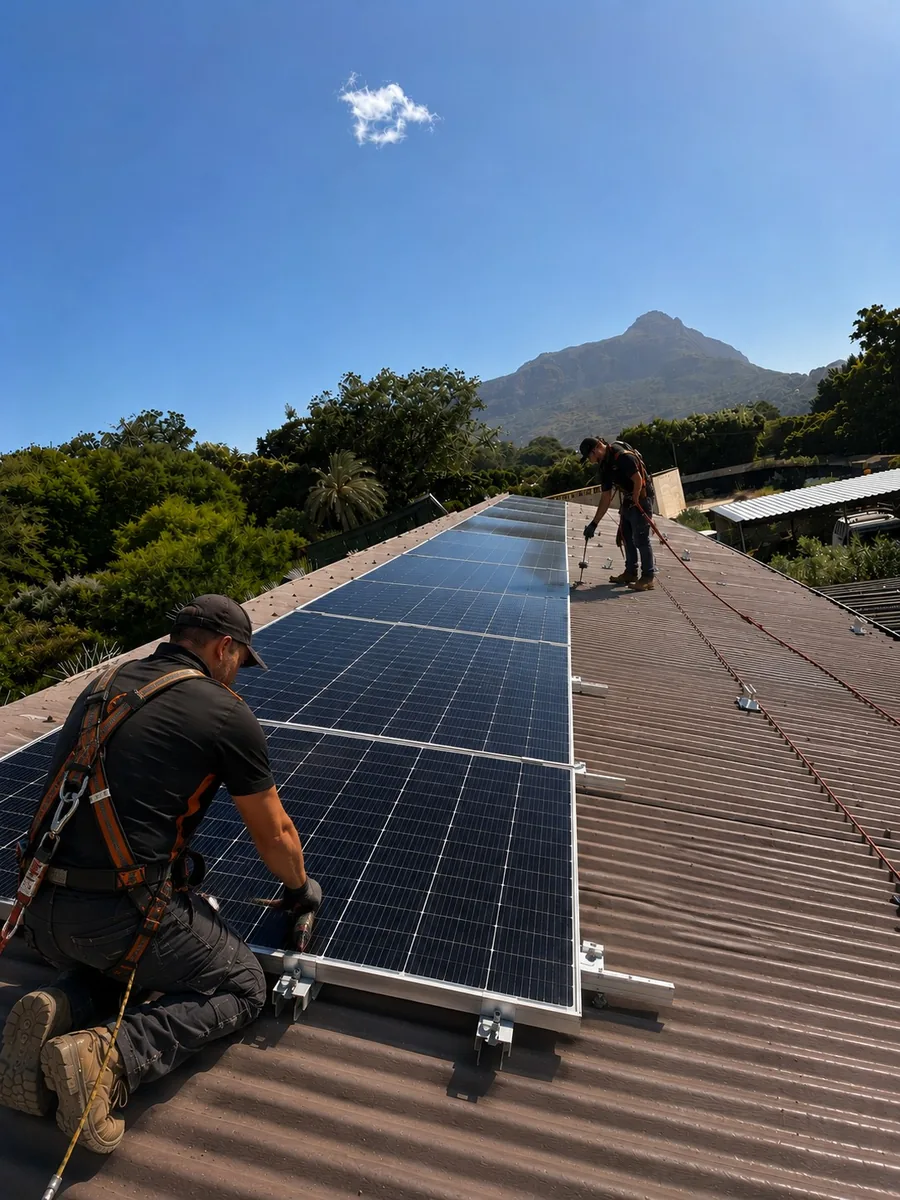
Thermo Group solar installation team working on a rooftop in Hout Bay

We Install It, Then We Look After It

Once your system is installed, tested, and registered, our relationship with you doesn’t end. We offer ongoing solar maintenance and fault-finding in Hout Bay, from the same team that knows the valley’s mist, mountain shading and harbour salt air — and already knows your system’s exact configuration.

Book Your Hout Bay Solar Installation Consultation

Fill out the form below to book a site visit and quote for a solar installation in Hout Bay. Already have solar and need a Certificate of Compliance too? See our dedicated Certificate of Compliance (COC) Services in Hout Bay page.

As trusted solar contractors serving Hout Bay, our qualified solar installers provide dedicated solar panel maintenance and PV system maintenance plans, so your investment keeps performing at its best for years to come.

We Don't Just Install — We Maintain

At Thermo Group, our relationship with our Hout Bay clients doesn’t end when the solar installation is complete.

We offer ongoing maintenance and servicing for Hout Bay solar systems, helping ensure equipment keeps operating safely and efficiently despite the valley’s mist and harbour salt air. Our team can assist with inspections, fault finding, inverter issues, battery systems, electrical connections and general system maintenance.

Regular maintenance can also help identify potential problems before they become expensive failures.

Thermo Group team installing a rack-mounted battery system

SSEG & City of Cape Town Registration

Installing a solar system is only part of the process. Where required, your system must also be properly documented and registered with the City of Cape Town.

Thermo Group can assist clients with the SSEG application and registration process, helping ensure that the required documentation, electrical compliance requirements and system information are correctly dealt with.

Our goal is to make the process as straightforward as possible for the property owner.

Your Local Solar Experts

From the initial site survey to installation, compliance, registration and ongoing maintenance, Thermo Group provides a complete solar solution for Hout Bay properties under one roof.

Driven by Quality. Powered by Trust.

More Solar Services

Explore our full range of solar installation and solutions services across Cape Town, find out more about our solar maintenance in Hout Bay, or see our Certificate of Compliance services in Hout Bay.

Solar for Hout Bay Estates, Slope Homes and Sectional Title Schemes

Before panel sizes and battery capacity, the first solar question in Hout Bay is usually who has to say yes. A large share of the valley’s homes sit in lifestyle estates, mostly on the mountain slopes, and a property-market article on these estates notes that boreholes and solar panels are already common features in many of them. Others are freehold houses, townhouses in clusters, smallholdings or older homes that have been altered over time.

Estates and homeowners’ associations

Estates normally have design rules that cover roof appearance, panel position and visible equipment, and some require approval before any contractor starts. Ask your trustees for the written rules first. A good installer will want to see them at the site visit, and will lay the array out to suit the rules instead of fighting them.

Sectional title

In a sectional title scheme the roof is usually common property. Putting panels on it normally needs the trustees’ consent and, depending on the scheme, a resolution or an exclusive-use arrangement for the roof area. Insurance, maintenance responsibilities and who owns the equipment should all be settled in writing before any work begins.

Older and heritage buildings

The valley includes buildings from the nineteenth century and earlier. Fixing panels to a structure more than 60 years old may count as altering it under the National Heritage Resources Act, which calls for a permit from the provincial heritage authority. Ask early and keep the array away from original features where possible.
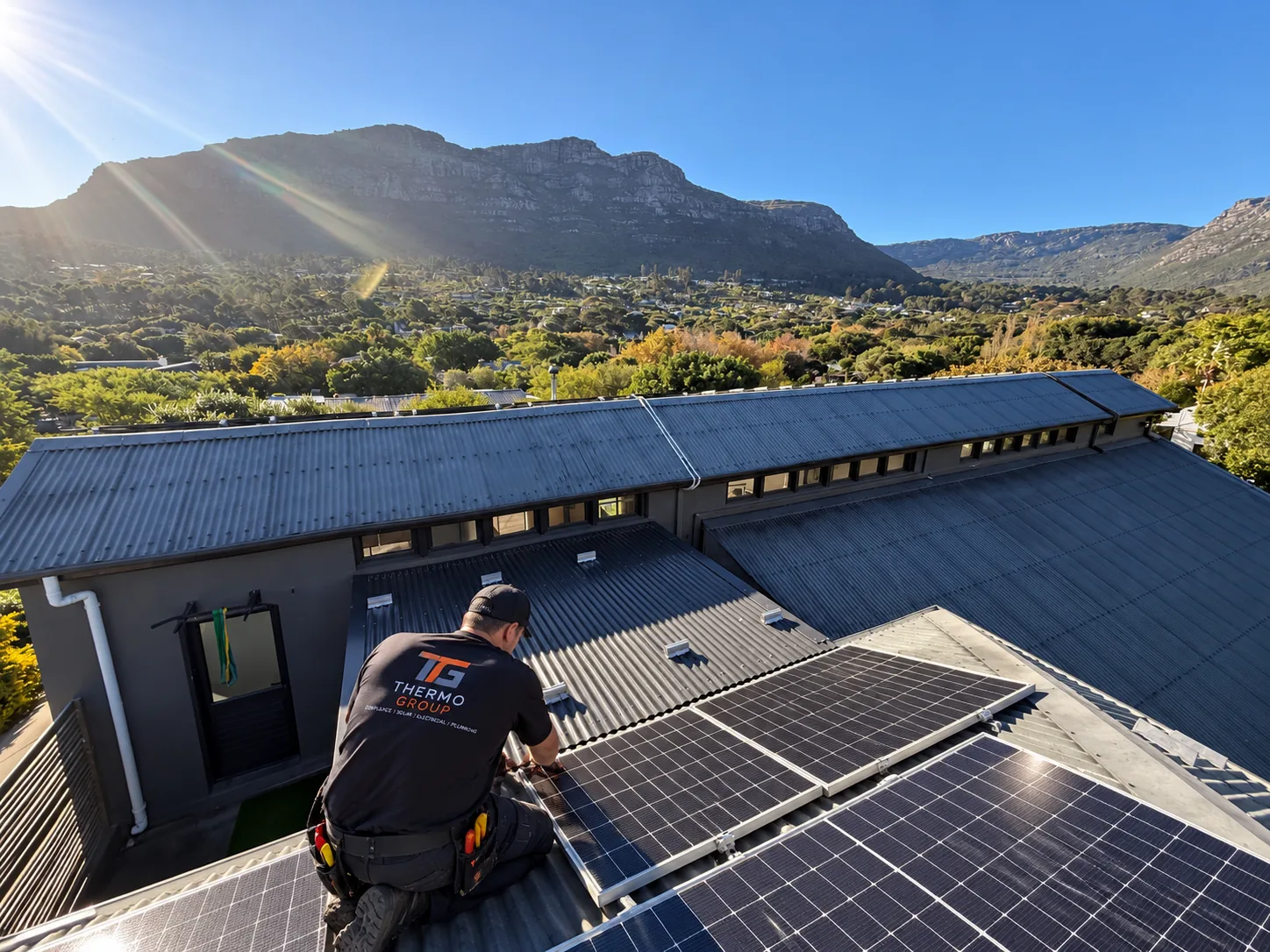
Solar panel installation in the Hout Bay valley

Roofs, Wind and Mounting Hardware in the Valley

Roof type drives the mounting method, and the roof has to be in good shape before anything is fixed to it. Corrugated iron and IBR sheeting take clamps or brackets fixed to the structure, tiled roofs take hooks beneath the tiles, and flat roofs take tilt frames that are either ballasted or fixed through the waterproofing, with every penetration sealed. Thatch is generally unsuitable for rooftop panels because of fire risk, and asbestos-cement roofs need specialist advice, since regulations restrict drilling and fast-moving cutting tools on that material.

Why wind deserves attention

Panels behave like sails. In Cape Town the summer south-easter is the main design consideration, and winter cold fronts bring strong north-westerly wind as well. Mountains can shelter one plot and leave the next more exposed, so neighbouring roofs may see different conditions. Ask your installer how the fixings, rail spacing and torque were chosen, and whether the roof structure was inspected where the brackets connect.

  • On pitched roofs, flush mounting usually beats tilting panels up, because the extra wind exposure is rarely worth the small gain.
  • Check the age and condition of the roof covering and timbers. An old roof is far easier to replace before the array goes on than after.
  • Look for corrosion-resistant fixings and fittings, especially on the lower slopes closer to the bay.
  • Ask who is responsible if a roof penetration leaks later, and get the answer in writing.

The City’s own going-solar guidance tells owners to confirm that the roof can carry the weight and wind load of the array. That is a reasonable question to put to any installer who quotes you.

What to Back Up: Load-Shedding Planning for Hout Bay Properties

A solar system can do three different things: cut your daytime consumption, keep selected circuits running when the grid fails, or both. Which of these matters most depends on how you use the property, and the table below shows how that tends to play out in the valley.

PropertyWhat usually matters mostDesign point
Estate family homeFridge, freezer, lights, Wi-Fi, gate and garageEssential-loads circuit on its own sub-board, battery sized for the evening, not the afternoon
Property with its own borehole or irrigationKeeping water available during an outageInverter sized for the pump’s starting surge, not only its running power
Holiday letGuests who expect lights, hot water and internet at all timesCareful choice of which loads are backed up, and clear instructions for guests
Small shop or restaurantRefrigeration, tills, card machines and lightingDaytime production matches trading hours, with batteries for critical loads only
Home officeComputers, router and one or two socketsA small battery may suffice, if the geyser and oven stay off the backed-up side

Winter is the test of any design. Cloud fronts and shorter days cut production just when evenings are longest, so ask to see the winter estimate as well as the annual one. A hybrid system, which is grid-tied with a battery, is the practical choice for most homes worried about outages. A grid-tied system without a battery switches itself off when the grid fails, which is a safety feature, so it will not keep your lights on.

The wiring has to be ready as well. Our electrician in Hout Bay page covers board splitting and surge protection, which often come first.

Registration, Certificates and Insurance in Hout Bay

Where your electricity account is with the City of Cape Town, a solar or battery system connected to your installation needs the City’s authorisation before installation and switch-on. Since 1 October 2023 all new solar and battery systems are treated as grid-tied for this purpose. Registration itself carries no fee, though a fee applies if you fail to register. Generating without commissioning approval can bring a contravention notice, a service fee and eventual disconnection.

The sequence that protects you

  1. The installer applies through the City’s online portal, using equipment from the City’s approved inverter list.
  2. If you live in an estate or scheme, written approval from the estate or trustees comes first.
  3. Next, the City grants a Permission to Install. Panels can go up, but the system stays switched off.
  4. After installation, an electrical Certificate of Compliance, the commissioning report and the supplemental contract go to the City, and an ECSA-registered professional signs off the commissioning report.
  5. Only when the City issues its commissioning letter is the system switched on.

A Certificate of Compliance and City registration are different things. The certificate shows the installation is safe, and the City’s authorisation is what allows it to connect. You need both. Properties supplied by Eskom or another municipality may have a different process, so check the current requirement with your supplier before you sign anything. Thermo Group handles the SSEG registration for the systems it installs.

Tell your insurer once the system is in so the schedule lists it, and keep the certificate, invoices and commissioning paperwork together. Insurers often ask for them after a claim. The solar certificate of compliance page lists the tests involved.


Solar installation with a mountain view in Hout Bay

Solar for Hout Bay Businesses: Harbour, Main Road and Markets

Hout Bay has a working fishing harbour, restaurants, markets, boat tours and a town centre of shops and offices. Those that trade in daylight use much of their electricity while the sun is up, which suits solar. A business should start from its trading hours, not from a panel count.

What a commercial design looks at

  • Load profile. Twelve months of consumption set against opening hours, shifts and weekends. A steady daytime load is ideal.
  • Tariff structure. Many City business tariffs combine energy charges, time-of-use periods and a peak demand charge. Solar cuts energy bought in the day, but it does not ensure a lower peak demand charge.
  • Roof or ground space. Age, structure, asbestos, access, and room for inverters and switchgear.
  • Salt exposure. Near the water, ask for corrosion-resistant fixings and enclosures, and for a maintenance plan that includes washing off deposits.
  • Lease terms. Landlords and tenants need to agree who pays for, owns and benefits from a system, and some leases restrict roof alterations.

Section 12B of the Income Tax Act has offered business owners a deduction on qualifying solar PV, but the rate and conditions have changed and depend on who owns the system, so check the current position with your accountant. Supplies above 100 A are on a different technical footing under the City’s requirements, and larger systems may need engineering studies, which affects both timing and design.

Our main solar installations in Cape Town page covers the wider service.

Choosing a Solar Installer in Hout Bay: Quote Checklist and Aftercare

A written quote is the best place to spot problems early. A proper Hout Bay quote should include:

  • Make, model and quantity of panels, inverter and batteries, with the battery’s usable capacity and chemistry.
  • System size in kWp, inverter size in kW and battery capacity in kWh.
  • Confirmation that the inverter is on the City’s approved list.
  • How the roof structure and wind load were assessed, and the mounting hardware specified.
  • Who handles estate approval, City registration and the electrical Certificate of Compliance.
  • Where the batteries will go: somewhere dry, ventilated, away from direct sun, escape routes and flammable storage.
  • What is backed up in an outage, and exclusions in writing.

Red flags

Treat a quote issued without anyone visiting the site with suspicion, as well as vague equipment descriptions, registration described as optional, or an “off-grid” label used to avoid it. The City stopped accepting standby and off-grid applications because many such systems were wired in a way that let them run in parallel with the grid. Pressure to pay in full upfront is another warning sign.

Credentials and aftercare

Thermo Group holds PV GreenCard, the quality-assurance programme for solar PV installers run through SAPVIA, and is a SAPVIA member. PV GreenCard is voluntary and is not a substitute for the electrical certificate. After installation, plan for periodic cleaning with water and a soft brush, and a yearly check of fixings, connectors, earthing and the inverter. Both are covered on our solar maintenance and solar repairs and fault finding pages.

We also serve Llandudno, Camps Bay, Constantia and Noordhoek. To discuss your property, request a free quote, or ring 021 203 5337 or 082 302 0683 to talk it through.

Solar Installers Hout Bay: More Questions Answered

If you live in an estate or sectional title scheme, usually yes. Estates commonly have design rules about roofs and visible equipment, and trustees may need to consent in writing. Get the rules first and have approval in hand before the City application, as the whole process depends on it.

Sometimes, but check first. A structure older than 60 years may not be altered without a permit from the provincial heritage authority, and panels fixed to a roof can count as an alteration. Raise it early so the layout can avoid original features and approval does not delay the job.

Properly designed and fixed arrays are built to cope with Cape wind, but the mounting matters. Flush-mounted panels on a sound roof, with correct rails, clamps and torque, are generally preferred over tilted frames. Ask how the fixings were chosen, and have the array checked after major storms.

It can, if the inverter is sized for the pump’s starting surge and not only its running power. Pumps are motors with a high starting current, and an undersized inverter will trip each time the pump starts. Your installer should check the pump’s rating and circuit before quoting.

A grid-tied system without a battery supplies your loads by day and shuts down when the grid fails. A hybrid system adds a battery and a protected essential-loads circuit, so selected circuits keep running in an outage. In Cape Town’s City supply area, both need City authorisation before switch-on.

Batteries belong in a dry, ventilated place that is racked properly, away from direct sun, escape routes and flammable materials. On a sloping site, think about drainage and access too. The battery circuit needs the correct protection and isolation, and the board may need splitting first.

If your account is with the City of Cape Town, a system that connects to your installation needs authorisation, including battery-only backup systems, because the City treats new systems as grid-tied. Rules and forms change, so confirm the current requirement before installation, and ask your supplier if you are not City-supplied.

It depends on when you use electricity, your tariff and your roof. Businesses that trade in daylight benefit most, since solar offsets energy bought in the day. It does not ensure a lower peak demand charge. A site visit and your bill history are the right starting point.

Book Your Hout Bay Solar Installation

Fill in your details below and our team will contact you to discuss your solar installation or maintenance needs in Hout Bay.

Quote Request Form

How much does solar installation cost in Hout Bay?

It depends on your household’s usage and system size — a small backup system for essentials during load shedding costs far less than a full system covering your whole home. We assess your usage and roof before quoting, so you get an accurate price rather than a generic estimate.


How long does a solar installation take in Hout Bay?

Most residential installations take 1 to 3 days on site, depending on system size and roof complexity, plus the time needed for approvals. We’ll give you a clear timeline once we’ve assessed your property.


Does Hout Bay’s valley setting affect a new installation?

Yes. Hout Bay’s valley traps moisture and morning mist more than drier parts of the Peninsula, so we specify equipment and mounting that can handle sustained damp conditions, not just occasional rain.


Will solar keep my home running during load shedding?

Yes. A correctly installed and configured solar and battery system will keep your essential circuits running during load shedding, and we handle the City of Cape Town’s SSEG registration and Notice of Completion as part of every installation.


Do you also handle compliance certificates and ongoing maintenance for the system?

Yes. We issue the Solar Certificate of Compliance your installation needs, and we offer ongoing maintenance and fault-finding to keep it performing well for years — whether we installed it or another company did.

Solar Installations & Maintenance in Hout Bay

Registered, experienced solar technicians serving Hout Bay’s valley and harbour properties — installation, compliance, registration and ongoing maintenance.

We Work With