Thermo Group — Solar Experts You Can Trust
Affordable solar installations for homes and businesses in Camps Bay — quality workmanship, transparent pricing, no premium mark-up.
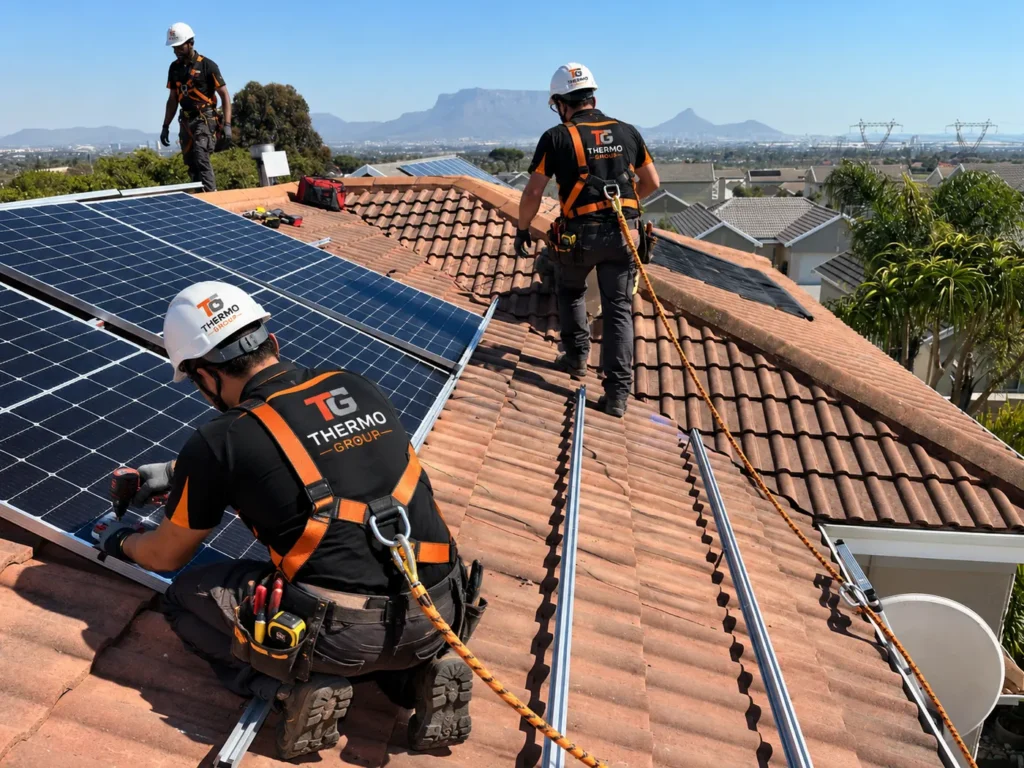
At Thermo Group, we install solar PV, battery and hybrid systems throughout Camps Bay — homes built into the slopes below the Twelve Apostles, where dramatic views come with strong downslope wind gusts, direct Atlantic salt air and steep, cliffside access. We design every Camps Bay system around those conditions from the first site visit, not as an afterthought.
Thinking about solar in Cape Town?
Free solar quotes, no obligation. Installation and City registration handled for you.
Free solar quote · no obligation
Tell us about your home in 5 quick steps
No prices on screen and no pushy sales. We call you back the same day, do a free site assessment, then send an accurate written quote.
Step 1 of 5
Where is the property?
Type of property
What do you need, and how much power do you use?
What are you looking for?
Roughly what is your monthly electricity bill?
Optional: a photo of a recent bill lets us size your system more accurately before we call. Skip this if you do not have one handy.
What must keep running when the power is off?
Tick anything specific you want covered (optional)
How would you prefer to pay?
This only helps us come prepared. You are not committing to anything and no amounts are shown here.
Where should we call you?
Best time to call
Preferred time for the free site assessment
By sending this you agree to our solar quote terms. We use your details only to contact you about this request.
Prefer to talk? Call 021 203 5337 or WhatsApp 082 302 0683
Our experienced team handles the complete solar installation process in Camps Bay — from surveying the property’s actual sun hours and shading, through design, installation, testing, compliance and registration.
Whether you’re looking for a solar PV system, battery backup, hybrid inverter or a complete energy solution, we design around your property’s electricity usage, roof and the mountain’s downslope wind and Atlantic salt air. We carry out both residential and commercial solar installations, and our technicians are experienced in installing and maintaining these systems for the long term.

Complete Solar Solutions
Our solar services include:
- ☀️ Solar panel installations
- 🔋 Battery storage systems
- ⚡ Hybrid and backup inverter systems
- 🏠 Residential solar installations
- 🏢 Commercial solar installations
- 🔧 Solar system upgrades and expansions
- 📋 Electrical compliance and certification
- 🏙️ SSEG applications and registration
- 📝 Solar system registration with the City of Cape Town
- 🔍 Solar system inspections and fault finding
- 🛠️ Ongoing solar maintenance and servicing
What We Design Around In Camps Bay
Mountain Downslope Wind Loading
Strong gusts funnel off the Twelve Apostles onto Camps Bay’s slopes. We size and fix racking for that load, not a standard coastal wind rating.
Direct Atlantic Salt Air
Beachfront apartments and homes higher up the slope both face direct Atlantic exposure. We specify marine-grade hardware throughout.
Steep-Access & Architectural Complexity
Cliffside properties and architecturally ambitious homes make access itself part of the job. We plan larger, more complex systems accordingly.
Why A Camps Bay Solar Installation Isn’t A Generic Cape Town Job
Camps Bay’s homes are built into the slopes below the Twelve Apostles, which means dramatic views but also some of the toughest physical conditions for a solar installation anywhere in Cape Town — strong downslope wind gusts off the mountain, direct Atlantic salt air, and steep, cliffside properties that make access itself part of the job. We don’t quote a Camps Bay installation off a standard template — our site visit accounts for wind loading and access before we design the system.

Engineering For Twelve Apostles Downslope Wind
The strong downslope gusts that funnel off the Twelve Apostles put real load on mounting hardware. We use wind-rated racking sized for Camps Bay’s specific exposure, from beachfront apartments on Victoria Road to homes higher up the slope.

Installing On Cliffside & Architecturally Complex Homes
Camps Bay’s larger, architecturally ambitious homes often mean more complex systems and access that needs careful planning from the outset. We scope that as part of the site visit, not as a surprise on installation day.
Book Your Camps Bay Solar Installation Consultation
Fill out the form below to book a site visit and quote for a solar installation in Camps Bay. Already have solar and need a Certificate of Compliance too? See our dedicated Certificate of Compliance (COC) Services in Camps Bay page.
As trusted solar contractors serving Camps Bay, our qualified solar installers provide dedicated solar panel maintenance and PV system maintenance plans, so your investment keeps performing at its best for years to come.
We Don't Just Install — We Maintain
At Thermo Group, our relationship with our Camps Bay clients doesn’t end when the solar installation is complete.
We offer ongoing maintenance and servicing for Camps Bay solar systems, helping ensure equipment keeps operating safely and efficiently despite the mountain’s downslope wind and Atlantic salt air. Our team can assist with inspections, fault finding, inverter issues, battery systems, electrical connections and general system maintenance.
Regular maintenance can also help identify potential problems before they become expensive failures.

SSEG & City of Cape Town Registration
Installing a solar system is only part of the process. Where required, your system must also be properly documented and registered with the City of Cape Town.
Thermo Group can assist clients with the SSEG application and registration process, helping ensure that the required documentation, electrical compliance requirements and system information are correctly dealt with.
Our goal is to make the process as straightforward as possible for the property owner.
Your Local Solar Experts
From the initial site survey to installation, compliance, registration and ongoing maintenance, Thermo Group provides a complete solar solution for Camps Bay properties under one roof.
Driven by Quality. Powered by Trust.
More Solar Services
Explore our full range of solar installation and solutions services across Cape Town, find out more about our solar maintenance in Camps Bay, or see our Certificate of Compliance services in Camps Bay.
Roof Types and Property Types in Camps Bay: What Will Carry the Panels
Local property profiles describe a mix of apartments, cottages, bungalows and large modern villas built against the mountain slopes. The roof under each is different, and the roof, not the panel, decides how a system is mounted.
- Flat concrete roofs are common on modern villas and apartment blocks. Panels sit on tilt frames, either fixed to the structure with a waterproofing detail at every penetration, or held down by ballast where the slab can take the weight. Which method is used depends on the structural assessment, not on convenience.
- Pitched tile and metal roofs take hooks under the tiles or clamps on the sheeting. The rafters and battens must be sound, because the hooks are only as strong as what they bolt into.
- Older roofs need extra care. Thatch is generally unsuitable for panels, and asbestos-cement sheeting must only be worked on by licensed contractors, because the regulations restrict drilling and cutting it. If you do not know what is on your roof, find out before you request quotes.
The City of Cape Town’s own checklist for going solar advises a structural assessment of roof weight and wind load, so ask any installer to explain how they have dealt with both. Wind loading on slopes is covered earlier on this page, and the way the roof is fixed is what keeps that engineering from being theoretical.
Salt Air, Corrosion and Keeping the System Healthy
Wind is only one part of living by the sea. Salt-laden air is gentler on a system than a storm, but it is relentless, and it attacks the parts that hold everything together rather than the glass itself.
What to ask about at the quoting stage
- Fixings and frames. Look for anodised aluminium and stainless steel fixings rather than plain galvanised hardware, and ask which grade has been specified.
- Cabling and connectors. UV-rated cable, properly crimped connectors and sealed glands stop moisture and salt creeping into joints.
- Inverter and battery position. A sheltered, dry, well-ventilated spot away from direct spray gives electronics a longer life than an exposed outside wall.
- Isolators and enclosures. Outdoor boxes should be sealed and rated for the exposure.
Cleaning and inspection
Salt and dust film on the glass reduces output. Clean with a soft brush and low-pressure water during the cooler hours, and never use a pressure washer or abrasive cleaners, which can damage the coating and the seals. Many inverters have an app, so a gradual drop in production compared with the same season last year is an early hint that cleaning or a technical check is due. Our solar maintenance page explains what a service visit covers, and solar repairs and fault finding covers systems that have stopped performing.
Apartments and Body Corporates: Going Solar in a Block
In a sectional title scheme, the roof and the outside walls are normally common property. That means an individual owner cannot simply put panels on the roof above their unit. Approval has to come from the body corporate, usually through the trustees and, for anything that changes the building, a formal resolution.
How to approach it
- Find out who decides. Read the scheme’s conduct rules and ask the managing agent how a request for roof use is handled.
- Decide what you are proposing. A system for common areas such as lifts, lights and pumps is a different project from one that serves a single unit, and the two have different wiring and metering.
- Present a plan. Trustees respond better to a clear layout, structural information, insurance details and a statement of who maintains what.
- Raise municipal requirements early. The City treats flats and group developments case by case, so registration should be discussed with the City from the start.
A common-area system can lower the running costs of a block for every owner, while a unit-level system needs agreement on cable routes, roof space and metering. Neither is a quick yes, so start the conversation before you ask for detailed quotes.
Older Buildings and Heritage Rules
Under section 34 of the National Heritage Resources Act, no one may alter or demolish a structure that is older than 60 years without a permit from the provincial heritage authority. Altering is read widely and covers work inside and outside. Panels bolted to the roof of an older building, and conduit run down its walls, can count as alterations.
Camps Bay began to develop as a seaside destination after Victoria Road opened in the late 1800s, so older buildings do exist, although many structures are younger than the 60-year threshold. The age of your own building is the deciding fact. Check the title deeds or the building plans, and ask your architect if you are unsure.
If approval is needed, the usual approach is to keep the layout as discreet as possible, for example by placing panels on lower or rear roof sections and running cable through existing ducts and voids. Raise the question before the design is finalised, because an installer cannot fix a missing permit after the panels are up.
Backup for Big Homes, Holiday Lets and Beachfront Businesses
A solar system is designed around the people and equipment it serves. Three situations come up in a suburb like this one.
Large homes with heavy loads
Pool pumps, air-conditioning, underfloor heating, lifts and EV chargers all draw large currents. A hybrid system should back up the essential circuits rather than the whole house, otherwise the battery and inverter would have to be sized for the biggest appliance in the building. The design question is which loads to protect and which to leave on the grid.
Homes that are let or left empty
If the property is let short-term or locked up for weeks, remote monitoring is worth having, so a fault does not go unnoticed. Ask about the inverter’s monitoring app and who receives the alerts. Make sure the fridge, security and router circuits are among those backed up.
Restaurants, bars and other commercial premises
Businesses with refrigeration, extraction and daytime trading often use much of their electricity while the sun is up, which suits solar well. The City’s commercial tariffs have peak, standard and off-peak periods, so a battery can sometimes shift consumption away from the expensive periods. Whether it pays depends on the tariff and the load profile, so insist that the design is based on the bills, not on a general rule.
Whichever case applies to you, the most useful document you can prepare before a site visit is a list of the circuits you cannot do without during an outage, with a rough idea of when each one is used. It lets the designer size the battery and inverter against real needs instead of guessing, and it makes quotes easier to compare.
Registration, Certificates and Insurance Before You Sign
Inside the City of Cape Town’s supply area, a solar or battery system that connects to your installation has to be registered as small-scale embedded generation before it is installed and switched on. The City now treats all new PV and battery installations as grid-tied, and it is no longer accepting applications for standby or off-grid systems in its supply area. Penalties apply to unregistered systems.
- Permission to Install. The City issues this first. It allows installation but not switch-on.
- Installation and certificate. The installer completes the work and a registered person issues the electrical certificate of compliance.
- Commissioning. A commissioning report is submitted and an ECSA-registered professional signs it off.
- Authorisation. Only after that can the system be switched on. A certificate of compliance alone does not authorise connection.
Thermo Group handles SSEG registration for its solar installations. Registration is the owner’s legal responsibility, so ask to see the paperwork. Tell your insurer once the system is in place and keep the certificate, invoices and equipment details. A PV GreenCard is the industry’s as-built report and is not a substitute for the electrical certificate. For more, see solar certificate of compliance.
A Quote Checklist and How to Choose an Installer in Camps Bay
A quote is the earliest place to spot problems. Compare any quote, ours included, against this list.
- make, model and quantity of the panels, inverter and batteries, with the battery’s usable capacity stated
- a roof assessment covering structure, waterproofing and how the frames are fixed
- what the backup circuit will carry, and what it will not
- who handles City registration, the certificate of compliance and the commissioning paperwork
- how corrosion has been addressed, from fixings to the position of the inverter
- what is covered by maintenance and whose job it is after installation
Be careful with a quote that skips the site visit, promises a fixed output, pushes you to sign quickly or leaves registration to you. Check the installer’s credentials: Thermo Group is an ECA member, a SAPVIA member and holds the PV GreenCard, and you can verify PV GreenCard holders on the PV GreenCard website.
For free quotes with no call-out fee, phone 021 203 5337 or 082 302 0683. Our main solar installations page covers the full service, and we also install in Clifton, Bakoven and Llandudno. If you need electrical work first, see our Camps Bay electricians.
Solar Installers Camps Bay: More Questions Answered
Yes, when the mounting is designed for it. Frames are either fixed through the slab with proper waterproofing at each penetration, or ballasted where the structure can carry the weight. Ask which method is proposed, how the waterproofing is detailed, and whether a structural check has been done.
The glass handles it well, but salt attacks fixings, connectors, cable glands and enclosures. Corrosion-resistant fixings, sealed connections and a sheltered position for the inverter reduce the risk. A salt film also lowers output, so occasional gentle cleaning with a soft brush and low-pressure water helps.
Not on your own. In sectional title, the roof is normally common property, so the body corporate must agree, often by trustee decision or resolution. Prepare a clear proposal covering layout, structure, insurance and maintenance, and raise the project with the managing agent before collecting detailed quotes.
If the building is older than 60 years, altering it needs a permit from the provincial heritage authority, and mounting panels or running conduit can count as alteration. Confirm the building’s age first. If a permit is needed, apply before the design is final.
A grid-tied system without a battery shuts down when the grid fails, so you still lose power. A hybrid system adds a battery and can supply a protected set of essential circuits during an outage. Both are treated as grid-connected by the City and need registration.
Yes. Inside the City of Cape Town’s supply area, any solar or battery system connected to your installation must be registered before it is switched on, whether or not it exports. A non-export system is handled differently on metering, so ask the installer to explain the process.
There is no fixed interval. Look at the glass and compare your inverter’s production with the same season in earlier months. When output falls without a change in weather, clean gently with a soft brush and low-pressure water in the cool of the day. Avoid pressure washers and abrasive products.
Most modern inverters offer a monitoring app or portal that shows production and faults remotely, provided the system has an internet connection. Ask which monitoring is included, who gets the alerts, and what happens to the backed-up circuits if the connection or power fails while you are away.
Book Your Camps Bay Solar Installation
Fill in your details below and our team will contact you to discuss your solar installation or maintenance needs in Camps Bay.
How much does solar installation cost in Camps Bay?
It depends on your household’s usage and system size — a small backup system for essentials during load shedding costs far less than a full system covering your whole home. We assess your usage and roof before quoting, so you get an accurate price rather than a generic estimate.
How long does a solar installation take in Camps Bay?
Most residential installations take 1 to 3 days on site, depending on system size and roof complexity, plus the time needed for approvals. We’ll give you a clear timeline once we’ve assessed your property.
Does it matter how high up the slope my Camps Bay home is?
Yes. Properties higher up the slope or closer to the water face stronger wind loading and salt air, which affects the mounting hardware and panel specification we recommend for a durable installation.
Will solar keep my home running during load shedding?
Yes. A correctly installed and configured solar and battery system will keep your essential circuits running during load shedding, and we handle the City of Cape Town’s SSEG registration and Notice of Completion as part of every installation.
Do you also handle compliance certificates and ongoing maintenance for the system?
Yes. We issue the Solar Certificate of Compliance your installation needs, and we offer ongoing maintenance and fault-finding to keep it performing well for years — whether we installed it or another company did.
Solar Installations & Maintenance in Camps Bay
Registered, experienced solar technicians serving Camps Bay’s slope and cliffside properties — installation, compliance, registration and ongoing maintenance.
Other Thermo Services In Camps Bay
- Certificate of Compliance Camps Bay
- Electrician Camps Bay
- Emergency Electrician Camps Bay
- Solar Maintenance & Repairs Camps Bay
See all Solar Installation areas in Cape Town or everything we offer in the Atlantic Seaboard.