Thermo Group — Solar Experts You Can Trust
Affordable solar installations for homes in Tokai — quality workmanship, transparent pricing, no premium mark-up.
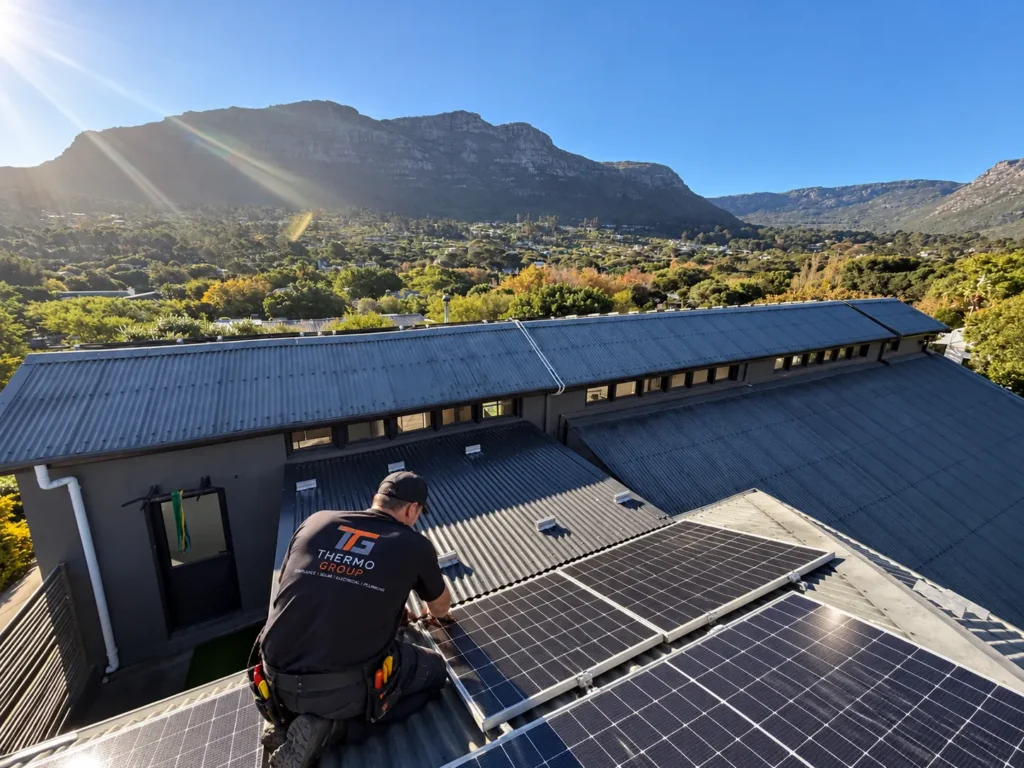
At Thermo Group, we install solar PV, battery and hybrid systems throughout Tokai — a leafy Southern Suburbs neighbourhood near Tokai Forest, known for larger stands, mature trees and a growing number of gated estate developments. We design every Tokai system around the property’s tree cover and stand size from the first site visit, not as an afterthought.
Thinking about solar in Cape Town?
Free solar quotes, no obligation. Installation and City registration handled for you.
Free solar quote · no obligation
Tell us about your home in 5 quick steps
No prices on screen and no pushy sales. We call you back the same day, do a free site assessment, then send an accurate written quote.
Step 1 of 5
Where is the property?
Type of property
What do you need, and how much power do you use?
What are you looking for?
Roughly what is your monthly electricity bill?
Optional: a photo of a recent bill lets us size your system more accurately before we call. Skip this if you do not have one handy.
What must keep running when the power is off?
Tick anything specific you want covered (optional)
How would you prefer to pay?
This only helps us come prepared. You are not committing to anything and no amounts are shown here.
Where should we call you?
Best time to call
Preferred time for the free site assessment
By sending this you agree to our solar quote terms. We use your details only to contact you about this request.
Prefer to talk? Call 021 203 5337 or WhatsApp 082 302 0683
Our experienced team handles the complete solar installation process in Tokai — from surveying the property’s actual sun hours and shading, through design, installation, testing, compliance and registration.
Whether you are looking for a solar PV system, battery backup, hybrid inverter or a complete energy solution, we design around your property’s electricity usage, roof and Tokai’s mature, tree-lined stands. We carry out both residential and commercial solar installations, and our technicians are experienced in installing and maintaining these systems for the long term.

Complete Solar Solutions
Our solar services include:
- ☀️ Solar panel installations
- 🔋 Battery storage systems
- ⚡ Hybrid and backup inverter systems
- 🏠 Residential solar installations
- 🏢 Commercial solar installations
- 🔧 Solar system upgrades and expansions
- 📋 Electrical compliance and certification
- 🏙️ SSEG applications and registration
- 📝 Solar system registration with the City of Cape Town
- 🔍 Solar system inspections and fault finding
- 🛠️ Ongoing solar maintenance and servicing
What We Design Around In Tokai
Mature Trees & Real Shading
Tokai’s proximity to the forest means mature trees genuinely shade many roofs. We map actual sun hours on site rather than assuming full exposure.
Larger Stands, Bigger Roofs
Tokai’s bigger stands often mean larger roof areas and pool equipment loads. We size systems around the property’s actual footprint, not a standard suburban default.
Gated Estate Developments
A number of Tokai properties fall under estate body corporate rules for rooftop installations. We help you navigate approvals so the project runs smoothly.
Why A Tokai Solar Installation Is Not A Generic Cape Town Job
Tokai is a leafy Southern Suburbs neighbourhood near Tokai Forest, known for larger stands, mature trees and a growing number of gated estate developments. That combination of real tree shading and bigger properties makes for an installation profile all its own. We do not quote a Tokai installation off a standard template — our site visit accounts for shading and stand size before we design a system.

Designing Around Tokai’s Tree Cover
Proximity to Tokai Forest means many properties have genuinely significant tree shading. We survey actual sun hours on site and design the system layout around it, rather than assuming a full-sun benchmark.
Book Your Tokai Solar Installation Consultation
Fill out the form below to book a site visit and quote for a solar installation in Tokai. Already have solar and need a Certificate of Compliance too? See our dedicated Certificate of Compliance (COC) Services in Tokai page.
As trusted solar contractors serving Tokai, our qualified solar installers provide dedicated solar panel maintenance and PV system maintenance plans, so your investment keeps performing at its best for years to come.
We Don't Just Install — We Maintain
At Thermo Group, our relationship with our Tokai clients does not end when the solar installation is complete.
We offer ongoing maintenance and servicing for Tokai solar systems, helping ensure equipment keeps operating safely and efficiently despite the suburb’s mature tree cover and leaf litter. Our team can assist with inspections, fault finding, inverter issues, battery systems, electrical connections and general system maintenance.
Regular maintenance can also help identify potential problems before they become expensive failures.
SSEG & City of Cape Town Registration
Installing a solar system is only part of the process. Where required, your system must also be properly documented and registered with the City of Cape Town.
Thermo Group can assist clients with the SSEG application and registration process, helping ensure that the required documentation, electrical compliance requirements and system information are correctly dealt with.
Our goal is to make the process as straightforward as possible for the property owner.
Your Local Solar Experts
From the initial site survey to installation, compliance, registration and ongoing maintenance, Thermo Group provides a complete solar solution for Tokai properties under one roof.
Driven by Quality. Powered by Trust.
More Solar Services
Explore our full range of solar installation and solutions services across Cape Town, find out more about our solar maintenance in Tokai, or see our Certificate of Compliance services in Tokai.
Solar on Tokai Roofs: Postwar Houses, Cottages and Townhouses
Tokai was developed from the late 1940s, so its roofs range from original postwar construction to recent builds and conversions. The age and type of roof is the first thing a solar design has to settle, because panels will be on it for a long time.
- Older pitched roofs. These may be tile or sheet, and some roofs from earlier decades could be asbestos-cement. That needs specialist advice before anyone drills, and nobody should walk on a roof that may contain it.
- Roof timbers and ceilings. An old roof structure should be checked for sound timbers and fixings. If the covering is near the end of its life, replace it before the panels go on.
- Extensions and flat roofs. Flat roofs take tilt frames, and every fixing through the waterproofing must be sealed.
- Cottages, garages and carports. A garden cottage or a carport can be easier and better placed than a main roof that is shaded.
North-facing planes give the best annual output in this hemisphere. East- and west-facing roofs still do a good job and even out production through the day, while south-facing planes are poor candidates. A site visit should also look at the distribution board and supply, since an old board may need work before a battery system can be connected.
Shade, Slopes and the Horizon: Designing Around Trees and the Mountain
Tokai sits on the foothills of the Constantiaberg, with mature trees on many properties and the park nearby. Shade is the main thing that separates a good estimate from an optimistic one.
- Check shade through the day and the year. Noon on a summer day tells you little. Ask the installer to show shading at different hours and in winter, when the sun sits lower.
- Ask about the horizon. On a hillside site, a ridge or tall trees can cut the sun earlier in the afternoon than the clock suggests. A site visit with a shade analysis tool will show whether it matters for your roof.
- Layout and wiring. Panels can be arranged in separate strings, or fitted with panel-level optimisers, so that one shaded corner does not drag down the whole array.
- Trees you do not control. Trees on a neighbour’s property or on park land are not yours to cut, so the design has to work with them.
- Leaf litter and droppings. Debris on the glass cuts output, and under tree cover it builds up faster than in open streets.
Where a main roof is poorly placed, a cottage, garage or ground mount may produce more over a year even if it looks less convenient.
Living Beside Table Mountain National Park: Fire, Debris and System Safety
Tokai Forest and Tokai Park are part of Table Mountain National Park and are managed by SANParks. The March 2015 Cape Peninsula fire spread to the Tokai area, and it is sensible for homes at the park edge to plan with fire in mind.
- Keep the roof and the area under the panels clear. Leaf litter and pine needles in gutters, behind panels and around the inverter are fuel as well as a nuisance.
- Isolators you can reach. DC and AC isolators should be accessible and clearly labelled, so that an electrician or emergency crew can see how to disconnect the system.
- Siting the inverter and battery. Choose a dry, ventilated spot away from escape routes, direct sun and flammable storage, and not next to a boundary full of vegetation.
- Tell your insurer. Ask what it expects of a property that borders a park or plantation.
After a fire or heavy smoke event near the property, do not touch the system or switch it back on until a qualified person has inspected the panels, cabling and inverter for heat or water damage.
Body Corporates, Estates and Older Cape Dutch Houses
Tokai’s housing includes townhouses, apartments and estates as well as freestanding homes, and a few old Cape Dutch houses survive from the wine-farming era. The approvals that apply depend on which you own.
- Sectional title. Roofs are usually common property, so the body corporate decides. Some schemes have exclusive-use areas, and trustees will usually want a roof plan, panel layout, mounting details and proof of the City’s authorisation process.
- Estates. Estate rules may cover where panels may go and how visible they can be. Ask for the design guidelines before the quote is finalised.
- Heritage. A house built in the late 1940s is now more than 60 years old. The National Heritage Resources Act (section 34) makes a heritage permit a prerequisite for changing a structure more than 60 years old, and the old Cape Dutch houses are likely to be older still. Whether fixing panels counts depends on how it is done, so check with Heritage Western Cape or an architect.
- Building plans. Panels mounted close to the roof usually do not need plans, but raised frames and ground mounts can.
Put every approval in writing and give a copy to the installer.
Backup for Tokai Households: What to Keep On
A battery should carry the loads that matter, not the whole house. This table shows a typical split.
| Load | Back it up? | Why |
|---|---|---|
| Fridge and freezer | Yes | Food safety, and a modest load |
| Lights and Wi-Fi router | Yes | Safety and working from home |
| Gate motor, intercom and alarm | Yes | Security during an outage |
| Laptops and home office equipment | Yes | Low load for the value |
| Geyser | Usually no | Heavy load, and a full tank holds its heat for hours |
| Oven and hob | No | Very heavy load |
| Pool pump and air-conditioning | Depends | Motors have a high start-up current |
| EV charger | No | Better charged from solar by day |
The battery size comes from the loads on the essential circuit and the hours you want them covered. Older distribution boards often have to be split so those loads sit on their own protected circuit, which is why a board upgrade sometimes comes first. Size for a cloudy winter week and not for the best day of summer.
City of Cape Town Registration: What Tokai Owners Should Expect
Tokai is supplied by the City of Cape Town, which means any solar or battery system connected to your installation needs the City’s authorisation before it is installed or switched on. A system without a battery is still grid-tied and still needs approval. Registration is free, but the City charges a fee if you fail to register.
- Before installation. The application goes through the City’s online portal, made by you or by the installer on your behalf.
- Permission to install. This lets the work proceed, but the system stays off.
- Commissioning. The City needs the electrical certificate of compliance, a commissioning report signed off by an ECSA-registered professional, and a supplemental contract.
- Switch-on. Only after the commissioning letter arrives.
Metering depends on whether you export. Feeding power back needs an advanced meter that the City fits at the owner’s cost, while a system that blocks export normally gets a prepayment meter at the City’s cost. Credit rates for exports change with each year’s tariff, so ask for the current figures instead of relying on an old quote. Switching on without approval can bring a contravention notice, a fee and ultimately disconnection. Thermo Group handles the SSEG registration on its own solar installations, and the paperwork is explained on our solar certificate of compliance page.
Shops, Schools and Small Businesses Around Tokai
Tokai has shopping centres such as Blue Route Mall and Steenberg Village Shopping Centre, and there are schools and other businesses nearby. Businesses like these tend to draw most of their power in daylight hours, so solar often suits them better than a home that stands empty all day.
- Load profile. Twelve months of bills or meter data, set against trading hours, decides the size of the system.
- Roof access and structure. Flat commercial roofs need ballasted or fixed frames, and the structure has to carry the extra weight and wind load.
- Tenants and landlords. A tenant needs the owner’s consent, and a lease should say who owns the equipment.
- Maintenance. A business depends on its system running, so cleaning, inspection and monitoring should be arranged. See our solar maintenance service.
You will not be charged for a quote or a call-out, and there is no obligation. To talk it through, phone 021 203 5337 or 082 302 0683. The main solar installations page lists every service. Installations are also available in Constantia, Bergvliet, Plumstead and Newlands.
Solar Installers Tokai: More Questions Answered
Only with specialist advice. Asbestos regulations restrict drilling and cutting with fast-moving tools, and no one should drill into or walk on a roof that may contain asbestos. The usual options are to replace the roof first, or to place the panels on a carport, garage or ground mount instead.
North-facing panels generally give the best output over a year in South Africa. East and west faces still work well and spread production across the morning and afternoon. South-facing roofs are poor candidates unless the array can go elsewhere. A site visit checks orientation, tilt and shade together.
Do not touch it or switch it back on until a qualified person has inspected it. Heat, smoke and water can damage panels, cabling, isolators and the inverter. Tell your insurer, keep photos of any damage and ask the installer or an electrician for a written inspection report.
The City’s guidance says plans are usually not needed for panels mounted close to the roof. Raised frames, taller ground mounts, estate design rules and heritage controls can change that. Check with your installer, your estate or body corporate and, for older houses, Heritage Western Cape.
Usually only with the body corporate’s consent, because roofs are commonly common property. Some schemes have exclusive-use areas that make it simpler. Trustees will normally want a roof plan, panel layout and details of the City’s authorisation process, so prepare these before you ask.
Yes, if your property is in the City’s supply area. The City has treated every new solar and battery installation as grid-tied since 1 October 2023, so authorisation is required before the system is installed and switched on. Registration is free, but a fee applies if you fail to register.
The City credits exported energy against your municipal account, but the credit rates change with each financial year’s tariff, so check the current figures. Exporting needs an advanced meter fitted at the owner’s cost. Systems designed to block export are still registered, and normally get a prepayment meter.
There is no fixed interval. Dust, leaf litter, pine needles and bird droppings all reduce output, so watch the inverter app and compare clear days. Clean early or late with clean water and a soft brush, and avoid pressure washers. Do not climb onto an unsafe roof, and have the work done by a professional.
Book Your Tokai Solar Installation
Fill in your details below and our team will contact you to discuss your solar installation or maintenance needs in Tokai.
How much does solar installation cost in Tokai?
It depends on your household’s usage, system size and how much tree shading affects your roof. We assess your usage and actual sun hours before quoting, so you get an accurate price rather than a generic estimate.
How long does a solar installation take in Tokai?
Most residential installations take 1 to 3 days on site, depending on system size and roof complexity, plus the time needed for approvals. We will give you a clear timeline once we have assessed your property.
Mature trees shade most of my roof — does solar still make sense?
Often, yes. We map your actual sun hours during the site visit and position panels to make the most of the exposure your roof genuinely has.
I live in a gated estate — do you handle the approval process?
Yes. Many Tokai properties fall under an estate’s body corporate or HOA rules for rooftop installations. We help prepare what is needed for approval as part of the project.
Do you also handle compliance certificates and ongoing maintenance for the system?
Yes. We issue the Solar Certificate of Compliance your installation needs, and we offer ongoing maintenance and fault-finding to keep it performing well for years — whether we installed it or another company did.
Solar Installations & Maintenance in Tokai
Registered, experienced solar technicians serving Tokai’s leafy, larger properties near the forest — installation, compliance, registration and ongoing maintenance.
Other Thermo Services In Tokai
- Certificate of Compliance Tokai
- Electrician Tokai
- Emergency Electrician Tokai
- Solar Maintenance & Repairs Tokai
See all Solar Installation areas in Cape Town or everything we offer in the Southern Suburbs.