Thermo Group — Solar Experts You Can Trust
Affordable solar installations for homes and businesses in Woodstock — quality workmanship, transparent pricing, no premium mark-up.
At Thermo Group, we install solar PV, battery and hybrid systems throughout Woodstock — an inner-city suburb close to the harbour, known for its heritage Victorian row houses and a wave of repurposed industrial buildings turned creative studios and offices. We design every Woodstock system around the property’s narrow footprint and building type from the first site visit, not as an afterthought.
Thinking about solar in Cape Town?
Free solar quotes, no obligation. Installation and City registration handled for you.
Free solar quote · no obligation
Tell us about your home in 5 quick steps
No prices on screen and no pushy sales. We call you back the same day, do a free site assessment, then send an accurate written quote.
Step 1 of 5
Where is the property?
Type of property
What do you need, and how much power do you use?
What are you looking for?
Roughly what is your monthly electricity bill?
Optional: a photo of a recent bill lets us size your system more accurately before we call. Skip this if you do not have one handy.
What must keep running when the power is off?
Tick anything specific you want covered (optional)
How would you prefer to pay?
This only helps us come prepared. You are not committing to anything and no amounts are shown here.
Where should we call you?
Best time to call
Preferred time for the free site assessment
By sending this you agree to our solar quote terms. We use your details only to contact you about this request.
Prefer to talk? Call 021 203 5337 or WhatsApp 082 302 0683
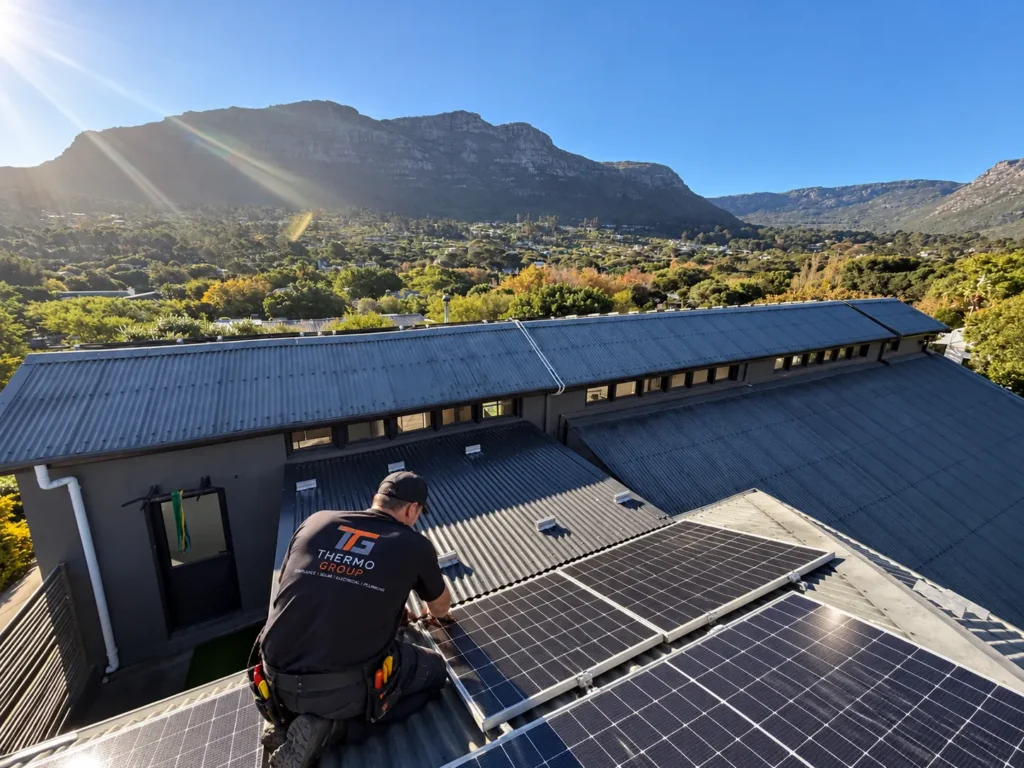
Our experienced team handles the complete solar installation process in Woodstock — from surveying the property’s actual sun hours and shading, through design, installation, testing, compliance and registration.
Whether you are looking for a solar PV system, battery backup, hybrid inverter or a complete energy solution, we design around your property’s electricity usage, roof and Woodstock’s mix of narrow row houses and repurposed industrial buildings. We carry out both residential and commercial solar installations, and our technicians are experienced in installing and maintaining these systems for the long term.

Complete Solar Solutions
Our solar services include:
- ☀️ Solar panel installations
- 🔋 Battery storage systems
- ⚡ Hybrid and backup inverter systems
- 🏠 Residential solar installations
- 🏢 Commercial solar installations
- 🔧 Solar system upgrades and expansions
- 📋 Electrical compliance and certification
- 🏙️ SSEG applications and registration
- 📝 Solar system registration with the City of Cape Town
- 🔍 Solar system inspections and fault finding
- 🛠️ Ongoing solar maintenance and servicing
What We Design Around In Woodstock
Narrow Victorian Row Houses
Woodstock’s rows of Victorian terrace houses have narrow roof footprints. We design panel layouts that make the most of a smaller space rather than assuming a wide suburban roof.
Repurposed Industrial Buildings
Woodstock’s creative studios and offices in converted industrial buildings often have flat roofs and higher daytime commercial usage. We size systems around each building’s actual profile.
Close To The Harbour
Properties nearer the harbour see slightly more salt-air exposure than suburbs further inland, a factor we account for in hardware selection.
Why A Woodstock Solar Installation Is Not A Generic Cape Town Job
Woodstock is an inner-city suburb close to the harbour, known for its heritage Victorian row houses and a wave of repurposed industrial buildings turned creative studios and offices. That combination of narrow residential roofs and converted commercial buildings makes for an installation profile all its own. We do not quote a Woodstock installation off a standard template — our site visit accounts for building type before we design a system.

Designing For Row Houses And Converted Buildings
Woodstock’s narrow Victorian row houses need a different panel layout approach than the flat-roofed, repurposed industrial buildings now common across the suburb. We design specifically for whichever type your property is.
Book Your Woodstock Solar Installation Consultation
Fill out the form below to book a site visit and quote for a solar installation in Woodstock. Already have solar and need a Certificate of Compliance too? See our dedicated Certificate of Compliance (COC) Services in Woodstock page.
As trusted solar contractors serving Woodstock, our qualified solar installers provide dedicated solar panel maintenance and PV system maintenance plans, so your investment keeps performing at its best for years to come.
We Don't Just Install — We Maintain
At Thermo Group, our relationship with our Woodstock clients does not end when the solar installation is complete.
We offer ongoing maintenance and servicing for Woodstock solar systems, helping ensure equipment keeps operating safely and efficiently across the suburb’s mix of row houses and converted commercial buildings. Our team can assist with inspections, fault finding, inverter issues, battery systems, electrical connections and general system maintenance.
Regular maintenance can also help identify potential problems before they become expensive failures.

SSEG & City of Cape Town Registration
Installing a solar system is only part of the process. Where required, your system must also be properly documented and registered with the City of Cape Town.
Thermo Group can assist clients with the SSEG application and registration process, helping ensure that the required documentation, electrical compliance requirements and system information are correctly dealt with.
Our goal is to make the process as straightforward as possible for the property owner.
Your Local Solar Experts
From the initial site survey to installation, compliance, registration and ongoing maintenance, Thermo Group provides a complete solar solution for Woodstock properties under one roof.
Driven by Quality. Powered by Trust.
More Solar Services
Explore our full range of solar installation and solutions services across Cape Town, find out more about our solar maintenance in Woodstock, or see our Certificate of Compliance services in Woodstock.
Roofs, Shade and Salt Air: Planning Solar in Woodstock
Woodstock lies between the Table Bay docks and the lower slopes of Devil’s Peak, and its buildings are very mixed. A narrow Victorian terrace, a restored semi, a converted factory and a modern apartment block each ask for a different kind of solar design. A site survey should cover at least the following.
- Roof covering and condition. Corrugated or IBR sheeting normally takes clamp-on rails, tiled roofs need purpose-made hooks, and flat roofs are fitted either with ballasted frames or with fixings through the waterproofing. Thatch is not suitable. Asbestos-cement roofing is a special case, because regulations restrict drilling and cutting it and a licensed contractor is needed.
- Structure. Older timber roof structures should be checked for condition and spacing before panels, rails and wind loads are added.
- Shading. Neighbouring buildings, the hill behind the suburb, chimneys, water tanks and trees can all shade part of an array at certain times of day. Shading analysis from the actual roof gives a far better picture than a rule of thumb.
- Wind. The south-easter blows across the Cape Peninsula from spring to late summer, so mounting systems and fixings must be designed for strong gusts.
- Salt air. Woodstock is close to the harbour, so ask the installer about corrosion-resistant fixings, cable glands and enclosures.
For an overview of the process in the whole metro, see our main solar installations in Cape Town page.
Fitting Panels to Narrow Terraces and Heritage-Sensitive Streets
Parts of Woodstock are declared heritage areas, according to the local residents’ association, and national legislation covers buildings that are over 60 years old. For solar, the practical question is how visible the panels will be from the street, and whether the work alters the roof of a protected building. Check with the City of Cape Town’s heritage section before you commit, particularly for a street-facing pitched roof.
Ways designers deal with this on older houses:
- Place panels on the rear or side slope of the roof, where they cannot be seen from the street, as long as that slope gets enough sun.
- Keep the array low and close to the roof surface, with tidy cable runs and no loose conduit visible.
- Choose dark panels and black frames and rails, which blend better with corrugated iron or slate-coloured roofs.
- Where the roof is small, split the array across two slopes or add a ground or garage-roof mount if the site has one.
- Run cables through existing ceiling voids instead of chasing walls.
Roofs on older houses were not designed with solar in mind. That makes the structural check on the roof timbers more than a formality, and it is one reason a generic online quote should be treated as a starting point only. Ask for the installer’s findings on the roof structure in writing, along with the proposed fixing method for your roof covering.
If the roof cannot take enough panels for your whole load, a smaller array with a battery can still reduce your reliance on the grid. The installer should explain what the system will and will not cover.
City of Cape Town Registration for Woodstock Solar Systems
Under the City of Cape Town’s rules, a solar PV or battery system connected to your property’s electrical installation must be registered as small-scale embedded generation (SSEG) before it is installed and before it is switched on. Since 1 October 2023, the City treats all new PV and battery systems as grid-tied, and it no longer accepts standby or off-grid applications. If your Woodstock property is on a City electricity account, these rules apply to you.
The usual steps
- An application is made through the City’s e-Services portal, by the owner or by an installer the owner has authorised.
- The City issues a permission to install. You may install, but not switch on, until the system has been commissioned.
- After commissioning, an ECSA-registered professional signs off the commissioning report, and the City confirms the system in writing.
- Only then may the system be switched on.
The City lists approved inverters, and manufacturer declarations on their own are not accepted. Registration itself carries no charge, but there are penalties for unregistered systems, which can include disconnection. Thermo Group handles SSEG registration for its solar installations. Rules change, so check the City’s current requirements before you commit to a design.
Choosing a System Type and Battery for Load-Shedding
Most Woodstock homes and small businesses end up choosing between three broad options. The City’s own definitions are a useful guide.
| System type | What it does | Typical fit |
|---|---|---|
| Grid-tied (no battery) | Uses solar during the day and the grid at other times. Switches off during an outage. | Offices and shops that work in daylight and do not need backup. |
| Hybrid (solar, inverter and battery) | Uses solar first, stores surplus, and keeps selected circuits running during an outage. | Homes and businesses that want lights, internet and a fridge to carry on. |
| Battery backup only | Charges from the grid and supplies chosen circuits during an outage. Also falls under the City’s SSEG rules. | Properties with little usable roof. |
Sizing the battery
List the loads you want to keep alive, such as lights, router, TV, fridge and a laptop, and how long you need them. Heavy loads like geysers, stoves and air conditioning are usually left off the backed-up circuits. Lithium iron phosphate batteries normally allow deeper daily use than lead-acid, and need less ventilation, but ask the installer to explain usable capacity and not just the label rating. The City limits battery charging current to a proportion of your main breaker, and requires an interlocked changeover for the essential loads, so the design must be done properly.
Body Corporates, Landlords and Shared Buildings
Woodstock has a lot of apartments, converted buildings and rented property, and in those situations the roof often belongs to someone else. Before you buy a system, settle the ownership questions:
- Sectional title. The roof is normally common property, so the trustees or body corporate must approve panels, cable routes and any battery location.
- Tenants. A tenant needs the landlord’s written consent. Ask what happens to the system when the lease ends, and who owns it.
- Multi-tenant commercial buildings. Decide whether the system serves one tenant’s meter or the building’s common supply. The City treats group developments and flats case by case.
- New owners. When a property with solar is sold, the new owner has to sign a new supplemental contract with the City, or authorise or decommission the system.
Putting all this in writing before installation avoids disputes later. The tax side also depends on who owns the system, because the section 12B deduction has been available for qualifying PV systems but its conditions have changed over time. Ask an accountant what applies to you.
Commercial Solar for Woodstock’s Workshops, Studios and Restaurants
Woodstock’s light industrial and commercial buildings often have large, low-pitch or flat roofs and daytime loads, which suit solar well. The business case for each building differs.
- Daytime operators. Offices, workshops and studios use most of their power while the sun is up, so a grid-tied system without a battery may be enough.
- Food businesses. Refrigeration and extraction run into the evening. A hybrid system can protect cold rooms and keep the kitchen’s essential circuits running during an outage.
- Time-of-use tariffs. Larger City customers are billed by time of use and often by demand, so a battery can shift some consumption away from peak periods. Check your tariff with your bill in hand.
- Larger systems. Bigger installations go through more detailed engineering review by the City.
Commercial quotes should state the supply capacity, how much of your load the system will cover and what happens during an outage. See our solar certificate of compliance page for the paperwork that follows an installation.
Checking a Solar Quote, Insurance and Aftercare
A quick checklist for any quote
- It asks for twelve months of bills and looks at the roof, rather than offering a standard package.
- It names the inverter and confirms it appears on the City’s approved list.
- It explains who handles the City’s SSEG application and the engineer’s sign-off.
- It includes a certificate of compliance for the electrical work. The PV GreenCard as-built report is voluntary and does not replace the certificate.
- It describes where batteries will be installed. They need a dry, ventilated, properly racked space.
Red flags
Be cautious about anyone who says registration is unnecessary, who quotes without seeing the roof, or who cannot show registration with a professional body. Thermo Group is a member of SAPVIA and holds the PV GreenCard. Always tell your insurer about the system and keep the invoices and the certificate.
Looking after the system
Panels should be cleaned with soft brushes and low-pressure water, never a pressure washer, and cleaned in the cooler hours of the day. Monitor production in the inverter app, so a drop in output shows up early. Our solar maintenance and solar repairs and fault-finding pages explain the aftercare options.
Free quotes are available, with no call-out fee and no obligation: 021 203 5337 or 082 302 0683, or request a quote. Nearby areas include Observatory, Gardens and Vredehoek.
Solar Installers Woodstock: More Questions Answered
Yes, if your property is on a City electricity account. The City requires registration before installation and before switch-on, and treats all new PV and battery systems as grid-tied. You may install once permission has been granted, but the system stays off until it is commissioned and confirmed. Check the City’s current requirements before you commit.
Not automatically. Buildings over 60 years old fall under national legislation, and parts of Woodstock are declared heritage areas. Panels on the rear or side slope, out of view from the street, are the easiest to justify. Ask the City’s heritage section before you sign an installation contract, and bring a simple layout plan.
A hybrid system combines solar panels, an inverter and a battery, so it can use the sun first, store the surplus and power chosen circuits during an outage. Battery-only backup charges from the grid and has no panels. Both fall under the City’s registration rules, and the better choice depends on your roof and your daytime and evening use.
Usually not on a typical home system. Geysers, stoves and air conditioners draw a lot of power and would need a very large inverter and battery. Most designs back up lights, internet, TV and a fridge, and leave heavy loads on the grid. Sometimes the cheapest saving is a geyser timer or a geyser conversion, done before any batteries are added.
The roof is normally common property, so the body corporate or trustees must approve the panels, the cable route and any battery location. Get the decision in writing, along with confirmation of who pays for maintenance and what happens to the system if you sell. The City also treats flats and group developments case by case.
The system usually stays with the property, but the new owner has to sign a new supplemental contract with the City, or authorise or decommission the system. Keep the registration letter, the certificate of compliance and the commissioning paperwork together, because buyers and conveyancers often ask for them.
Yes. The roof and the electrical installation belong to the landlord, so a tenant needs written consent. Agree in writing who owns the system, who insures it, who maintains it and what happens when the lease ends. The City’s registration is normally made by the property owner or an authorised installer.
Ask for proof of professional registration, a reference you can phone, the inverter model and confirmation that it is on the City’s approved list. Check who will do the SSEG registration and the sign-off, and that a certificate of compliance is included. Installers can also be looked up on the PV GreenCard website.
Book Your Woodstock Solar Installation
Fill in your details below and our team will contact you to discuss your solar installation or maintenance needs in Woodstock.
How much does solar installation cost in Woodstock?
It depends on your property’s usage, system size and building type — a converted industrial building can differ significantly from a Victorian row house. We assess your usage and roof before quoting, so you get an accurate price rather than a generic estimate.
How long does a solar installation take in Woodstock?
Most residential installations take 1 to 3 days on site, depending on system size and roof complexity, plus the time needed for approvals. We will give you a clear timeline once we have assessed your property.
My roof is narrow — is there enough space for solar?
Usually, yes. We design layouts specifically for Woodstock’s narrower row-house roofs, making the most of the space available.
Do you install solar on converted industrial and commercial buildings?
Yes. We regularly design and install systems on Woodstock’s repurposed industrial buildings, alongside standard residential installations.
Do you also handle compliance certificates and ongoing maintenance for the system?
Yes. We issue the Solar Certificate of Compliance your installation needs, and we offer ongoing maintenance and fault-finding to keep it performing well for years — whether we installed it or another company did.
Solar Installations & Maintenance in Woodstock
Registered, experienced solar technicians serving Woodstock’s heritage homes and creative industrial buildings — installation, compliance, registration and ongoing maintenance.
Other Thermo Services In Woodstock
- Certificate of Compliance Woodstock
- Electrician Woodstock
- Emergency Electrician Woodstock
- Solar Maintenance & Repairs Woodstock
See all Solar Installation areas in Cape Town or everything we offer in the City Bowl.