Thermo Group — Solar Experts You Can Trust
Affordable solar installations for homes in Gardens — quality workmanship, transparent pricing, no premium mark-up.
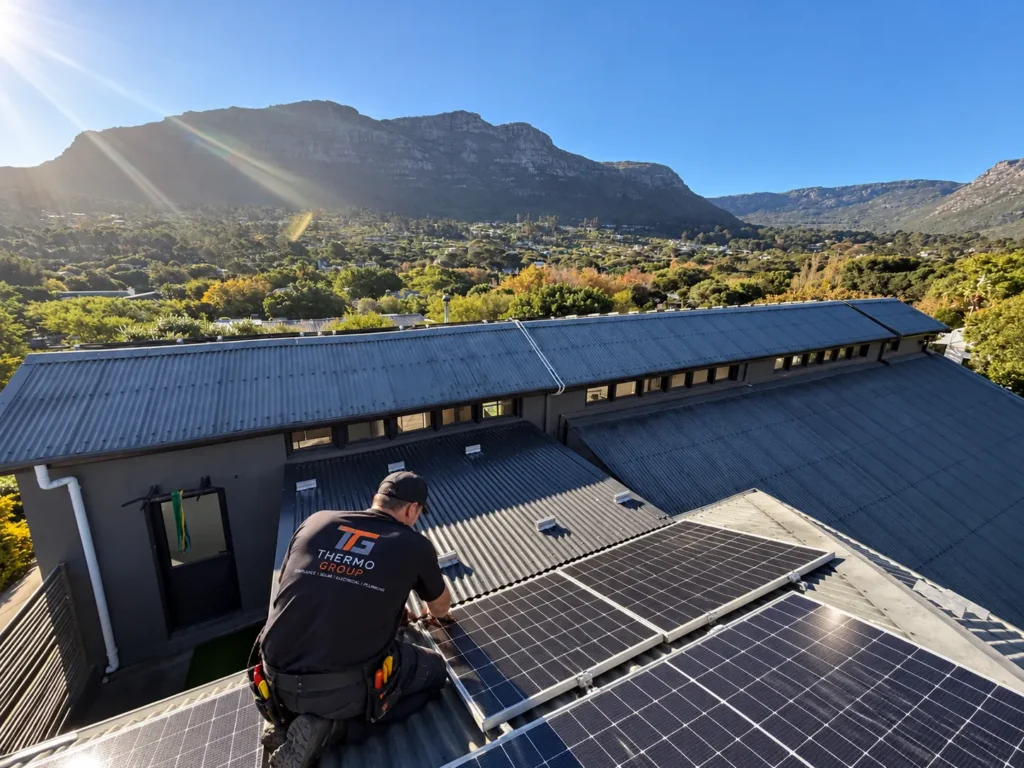
At Thermo Group, we install solar PV, battery and hybrid systems throughout Gardens — one of the City Bowl’s oldest suburbs, set on the lower slopes of Table Mountain with narrow one-way streets and a mix of Victorian and Edwardian homes close to the CBD. We design every Gardens system around the mountain’s afternoon shading from the first site visit, not as an afterthought.
Thinking about solar in Cape Town?
Free solar quotes, no obligation. Installation and City registration handled for you.
Free solar quote · no obligation
Tell us about your home in 5 quick steps
No prices on screen and no pushy sales. We call you back the same day, do a free site assessment, then send an accurate written quote.
Step 1 of 5
Where is the property?
Type of property
What do you need, and how much power do you use?
What are you looking for?
Roughly what is your monthly electricity bill?
Optional: a photo of a recent bill lets us size your system more accurately before we call. Skip this if you do not have one handy.
What must keep running when the power is off?
Tick anything specific you want covered (optional)
How would you prefer to pay?
This only helps us come prepared. You are not committing to anything and no amounts are shown here.
Where should we call you?
Best time to call
Preferred time for the free site assessment
By sending this you agree to our solar quote terms. We use your details only to contact you about this request.
Prefer to talk? Call 021 203 5337 or WhatsApp 082 302 0683
Our experienced team handles the complete solar installation process in Gardens — from surveying the property’s actual sun hours and shading, through design, installation, testing, compliance and registration.
Whether you are looking for a solar PV system, battery backup, hybrid inverter or a complete energy solution, we design around your property’s electricity usage, roof and the mountain-facing shading pattern common across Gardens. We carry out both residential and commercial solar installations, and our technicians are experienced in installing and maintaining these systems for the long term.

Complete Solar Solutions
Our solar services include:
- ☀️ Solar panel installations
- 🔋 Battery storage systems
- ⚡ Hybrid and backup inverter systems
- 🏠 Residential solar installations
- 🏢 Commercial solar installations
- 🔧 Solar system upgrades and expansions
- 📋 Electrical compliance and certification
- 🏙️ SSEG applications and registration
- 📝 Solar system registration with the City of Cape Town
- 🔍 Solar system inspections and fault finding
- 🛠️ Ongoing solar maintenance and servicing
What We Design Around In Gardens
Table Mountain Afternoon Shading
Properties on Gardens’ lower slopes often lose direct sun earlier in the afternoon as the mountain casts its shadow. We map actual sun hours on site rather than assuming a standard Cape Town exposure.
Older Victorian & Edwardian Homes
Many Gardens homes were built well before solar existed. We assess the distribution board and roof structure carefully before finalising a design on these older properties.
Narrow One-Way Streets
Gardens’ narrow, one-way street layout affects how we plan equipment access and delivery logistics, something we account for at the quoting stage, not on installation day.
Why A Gardens Solar Installation Is Not A Generic Cape Town Job
Gardens is one of the City Bowl’s oldest suburbs, set on the lower slopes of Table Mountain with narrow one-way streets and a mix of Victorian and Edwardian homes close to the CBD. That combination of mountain shading, older housing stock and restricted street access makes for an installation profile all its own. We do not quote a Gardens installation off a standard template — our site visit accounts for shading and access before we design a system.

Mapping Table Mountain’s Shadow
Properties closer to the mountain lose direct sun earlier than those further down the slope. We survey actual sun hours on site so your system is sized and positioned around real, not assumed, exposure.
Book Your Gardens Solar Installation Consultation
Fill out the form below to book a site visit and quote for a solar installation in Gardens. Already have solar and need a Certificate of Compliance too? See our dedicated Certificate of Compliance (COC) Services in Gardens page.
As trusted solar contractors serving Gardens, our qualified solar installers provide dedicated solar panel maintenance and PV system maintenance plans, so your investment keeps performing at its best for years to come.
We Don't Just Install — We Maintain
At Thermo Group, our relationship with our Gardens clients does not end when the solar installation is complete.
We offer ongoing maintenance and servicing for Gardens solar systems, helping ensure equipment keeps operating safely and efficiently despite the suburb’s mountain shading and older wiring. Our team can assist with inspections, fault finding, inverter issues, battery systems, electrical connections and general system maintenance.
Regular maintenance can also help identify potential problems before they become expensive failures.

SSEG & City of Cape Town Registration
Installing a solar system is only part of the process. Where required, your system must also be properly documented and registered with the City of Cape Town.
Thermo Group can assist clients with the SSEG application and registration process, helping ensure that the required documentation, electrical compliance requirements and system information are correctly dealt with.
Our goal is to make the process as straightforward as possible for the property owner.
Your Local Solar Experts
From the initial site survey to installation, compliance, registration and ongoing maintenance, Thermo Group provides a complete solar solution for Gardens properties under one roof.
Driven by Quality. Powered by Trust.
More Solar Services
Explore our full range of solar installation and solutions services across Cape Town, find out more about our solar maintenance in Gardens, or see our Certificate of Compliance services in Gardens.
Solar for Houses, Flats and Mixed-Use Buildings in Gardens
Gardens is unusual in how it mixes building types. Property profiles describe apartments and free-standing houses side by side, from Victorian semi-detached homes to modern studios, with restaurants, shops, medical suites and creative businesses in the same streets. Who owns the roof, and what it is made of, decides what is possible.
- Free-standing and semi-detached houses. The owner controls the roof, so the questions are technical: structure, material, orientation and shading. Older pitched roofs come in several materials, and the installer must identify the one you have before choosing a mounting method.
- Apartment blocks. The roof is usually common property, so the project has to go through the body corporate. Rooftop solar for a single unit is rarely straightforward.
- Mixed-use and commercial buildings. Owners often have more freedom, but tenants, landlords and leases add their own conditions.
Our current page describes how Table Mountain affects shading. This section looks at the practical side of ownership, approval and paperwork that decides whether a design ever leaves the drawing board.
What a proper first visit covers
Before any design is drawn, the installer should get onto the roof, look at the structure and the roof covering, inspect the distribution board and the main supply, and ask to see recent electricity bills. They should also ask who else needs to agree to the project, from a landlord to a body corporate. A quote produced without that visit is built on assumptions, and assumptions are where most surprises begin.
Heritage Approval and Visibility in the City Bowl
If your building is older than 60 years, section 34 of the National Heritage Resources Act applies. It says no structure of that age may be altered or demolished without a permit from the provincial heritage resources authority. Altering is read broadly and applies inside and outside, so fixing panels to a roof and running cable down a wall may be caught.
In the City Bowl, an urban conservation panel run by the Cape Town City Bowl Ratepayers’ and Residents’ Association reviews applications for alterations to older buildings and passes comments to Heritage Western Cape. Gardens is within the area it serves. The panel’s concern is the character of the building and the streetscape, so the visible impact of a solar installation matters.
Ways to reduce visual impact
- place panels on roof sections that cannot be seen from the street
- on a flat roof, set frames behind a parapet where one exists
- run cable through existing ducts, voids and ceiling spaces instead of fixing conduit to a facade
- choose a low-profile mounting and a matt finish where the choice exists
Ask early whether your building needs a permit. A design can often be changed to suit the rules, but not once the panels are on the roof.
A Shared Roof: Getting Solar Approved in a Sectional Title Scheme
Because the roof of a block is normally common property, a flat owner cannot make the decision alone. The route is slower than for a house, but it is well defined.
- Define the project. A common-area system for lifts, lighting and pumps cuts the building’s running costs for everyone. A system that serves one unit raises questions about roof space, cable routes, metering and who maintains what.
- Talk to the trustees and managing agent. Find out how the scheme handles requests, whether a formal resolution is needed, and what the conduct rules say about changes to common property.
- Prepare a package. Include a layout, a structural opinion, insurance details, the way cables will be routed and a maintenance plan.
- Check the municipal side. The City of Cape Town treats flats and group developments case by case, so raise registration with the City from the outset.
- Agree the cost-sharing. Whoever pays, the arrangement should be in writing.
This takes patience. Owners who start by building consensus, rather than by requesting quotes, usually move faster. It also helps to give trustees something to say yes to: a short, plain proposal with a drawing, the structural opinion and a clear statement that the scheme carries no risk it has not agreed to. Vague requests tend to be deferred, while specific ones can be put to a vote.
Table Mountain Shading: How to Judge Whether It Matters
Gardens lies at the foot of Table Mountain, and the mountain can cut off direct sun at certain hours. Whether that matters depends on your exact roof, the time of year, and how your household uses power. A confident installer will not guess. A shade analysis, done on site or with design software, shows which parts of the roof lose sun and when.
Questions to ask about shading
- Which hours and seasons are affected? Shading late or early in the day costs less than shading through the middle of it, because the middle of the day is when most energy is produced.
- How will the design handle partial shade? Panel layout, string arrangement and, in some cases, module-level electronics can limit the effect of a shaded section on the rest of the array.
- Is another roof section better? A smaller array on clean sun can outperform a larger one that is shaded.
- Does your usage match the sun? A household that uses most power in the evening depends more on the battery than on the exact hours of sun.
If the analysis shows that shading would make the economics weak, a good installer will say so, and may suggest a smaller system, a different layout or no panels at all. See our solar installations page for how we approach design in general.
Batteries in Flats and Offices: Where They Go and What to Check
In a house, a battery usually goes in a garage or utility room. In a flat or an office, space is tighter and the safety questions matter more.
- Position. The City’s checklist advises that batteries be properly racked in a dry, ventilated room. Avoid cramped cupboards, damp areas and anything that blocks an escape route.
- Chemistry. Most new systems use lithium iron phosphate, which has a built-in battery management system. Read the data sheet for usable capacity, not just the headline figure.
- What it carries. In a small space, a battery for lights, router, fridge and a few sockets is realistic. Geysers, ovens and heaters are better left off the backed-up circuit.
- Permission. A body corporate or landlord may have rules about battery placement, fire safety and insurance. Get their position in writing.
- Insurer. Tell your insurer, and ask whether placement or fire protection conditions apply.
Even without panels, a battery and inverter charged from the grid has to be registered with the City of Cape Town before it is switched on, because the City treats these systems as grid-connected. For electrical work around the system, see our electricians in Gardens.
Paperwork: Registration, Certificates and Selling the Property Later
Solar in the City of Cape Town’s supply area comes with a paper trail, and keeping it in order protects both the system and the sale of the property.
- Permission to Install from the City, which allows installation but not switch-on.
- Electrical certificate of compliance and test report issued by a registered person.
- Commissioning report, signed off by an ECSA-registered professional before the City authorises connection.
- PV GreenCard as-built report, which records the installation. It is a useful extra, but it does not replace the certificate of compliance.
- Equipment data sheets and invoices, which your insurer may ask for.
Thermo Group takes care of SSEG registration for the installations it carries out. If you later sell, the City’s requirements say a new owner has to sign a new supplemental contract, and either authorise the system or have it decommissioned, so tell your conveyancer about the system early. Any modification or expansion, such as extra panels or a larger battery, needs a fresh application. Read more on our solar certificate of compliance page.
Offices, Medical Suites and Restaurants: Solar for Daytime Businesses
Many Gardens businesses are open during the day, which suits solar. Consulting rooms, offices, studios and cafes use electricity while the sun is up, and refrigeration runs all day. The question is how much of that consumption a roof can cover, and whether a battery helps.
The City’s commercial tariffs have peak, standard and off-peak periods, and a battery can sometimes shift consumption out of the expensive periods. Whether it makes sense depends on your bills, so ask for a design based on twelve months of consumption data. Commercial customers also need to look at ownership: tax treatment of solar has changed over the years, and the owner of the system matters, so check with your accountant.
Tenants should start with the landlord, because the roof and the supply belong to the building. A written agreement should say who owns the system, who maintains it and what happens at the end of the lease.
Choosing an installer
Ask for a site visit, a shade analysis, a clear scope for registration and certification, and the credentials behind the work. Thermo Group is an ECA member, a SAPVIA member and holds the PV GreenCard. Free quotes carry no call-out fee: call 021 203 5337 or 082 302 0683.
We also install in Tamboerskloof, Vredehoek, Oranjezicht and Higgovale. For service after installation, see solar maintenance.
Solar Installers Gardens: More Questions Answered
The body corporate, because the roof is normally common property. The trustees usually decide, sometimes through a formal resolution, and the scheme’s conduct rules apply. Present a layout, structural opinion, insurance and maintenance details, and raise municipal registration early, since the City treats flats and group developments case by case.
It can matter in older parts of the City Bowl. If your building is over 60 years old, altering it needs a heritage permit, and visual impact is part of how proposals are judged. Placing panels on hidden roof sections, behind a parapet and running cable through existing ducts all reduce visibility.
The City’s requirements say the new owner has to sign a new supplemental contract and either authorise the system or decommission it. Tell your conveyancer about the system early and hand over the certificate of compliance, commissioning report and registration documents so the buyer can complete the process.
Choose a dry, ventilated, accessible position that is not in an escape route or a cramped cupboard, with the battery properly racked or mounted. Check the body corporate’s rules and your insurer’s conditions first. A battery needs registration with the City before switch-on, even without panels.
Not necessarily, but it can reduce output across the string it affects. Layout, string arrangement and in some cases module-level electronics limit the effect. A shade analysis before design shows which parts of the roof lose sun, so the panels can be placed where they work best.
Often, if it uses most of its electricity during the day and has access to a suitable roof. Ask for a design based on twelve months of consumption data, and agree ownership and maintenance with the landlord. Check whether a battery would help under the City’s time-of-use tariffs.
Keep the City’s Permission to Install and authorisation, the electrical certificate of compliance and test report, the commissioning report, the PV GreenCard as-built report, equipment data sheets, invoices and any maintenance records. Insurers, conveyancers and future owners may all ask for them.
Yes, but the City treats a modification or expansion as a fresh application, so it has to be registered before it is switched on. Mention future plans to the installer at the start, so the inverter, wiring and main breaker limits are chosen with room to grow.
Book Your Gardens Solar Installation
Fill in your details below and our team will contact you to discuss your solar installation or maintenance needs in Gardens.
How much does solar installation cost in Gardens?
It depends on your household’s usage, system size and how much mountain shading affects your roof. We assess your usage and actual sun hours before quoting, so you get an accurate price rather than a generic estimate.
How long does a solar installation take in Gardens?
Most residential installations take 1 to 3 days on site, depending on system size, roof complexity and street access, plus the time needed for approvals. We will give you a clear timeline once we have assessed your property.
Table Mountain shades my roof in the afternoon — does solar still make sense?
In most cases, yes. We map your actual sun hours during the site visit and design a system sized around your real exposure, rather than assuming full-day sun.
Will solar keep my home running during load shedding?
Yes. A correctly installed and configured solar and battery system will keep your essential circuits running during load shedding, and we handle the City of Cape Town’s SSEG registration and Notice of Completion as part of every installation.
Do you also handle compliance certificates and ongoing maintenance for the system?
Yes. We issue the Solar Certificate of Compliance your installation needs, and we offer ongoing maintenance and fault-finding to keep it performing well for years — whether we installed it or another company did.
Solar Installations & Maintenance in Gardens
Registered, experienced solar technicians serving Gardens’ Table Mountain-facing, character properties — installation, compliance, registration and ongoing maintenance.
Other Thermo Services In Gardens
- Certificate of Compliance Gardens
- Electrician Gardens
- Emergency Electrician Gardens
- Solar Maintenance & Repairs Gardens
See all Solar Installation areas in Cape Town or everything we offer in the City Bowl.